Author: PIC

  • Why Grass-Fed Beef and Lamb – Part 5, Community Benefits

    Why Grass-Fed Beef and Lamb – Part 5, Community Benefits

    In Part 2 of this series we discussed environmental health benefits to grass-fed farming.  Our reliance on perennial pastures and hay fields means we can produce proteins with less diesel fuel and no herbicides (glycophosphate or roundup).  Actually our reliance on off farm inputs is extremely low.   We manage the land in a sustainable fashion in harmony with our livestock, neighbors and our community.  This benefits the community by making a healthy environment for us all to live in and enjoy.  

    In Part 4 of the series we discussed the benefits to human health.  I think we can all understand how it benefits the community if we are all in better health.  Our health care system will not be burdened with chronic health related issues from a bad diet, neither will our pocket books be burdened with either the bills or tax bills to pay for those chronic diseases caused by bad diets.  Each and everyone of us benefits when we are a little healthier.  

    I think we can all see that those benefits can be great.  Possibly the greatest benefit to Grass-fed is that it is local.  We are members of this community.  I buy my tractors in Alliance, repair them in Randolph, hire people from Palmyra, Kent, Ravenna and Columbiana.  My veterinarian is from Homeworth.  My livestock minerals come from a small farmer in Leetonia. Our fencing supplies come from Minerva, along with my hay equipment.  I get my hardware in Edinburg; my drainage supplies from Marlboro.  We are a local company that supports other local companies.  

    When the pandemic started there was a meat shortage, why?  Because it is not local.  The average steak travels farther in the previous year than you did.  It has been determined from birth to your plate the AVERAGE distance that meat travels is 1800 miles.  That is right, it might be born in Mississippi in February, shipped out west to graze the summer, then to Louisiana to graze the winter, then to a feedlot in Kansas and on to the upper midwest to slaughter.  This is where it enters the food distribution system, large processing companies that hire mostly non-citizens had outbreaks of the virus.  There are only 5 companies in the US that control 80% of our beef production.  With this highly concentrated supply chain there is no resiliency.  So as these shops had to curtail production the meat supply disappeared.  As a grass-fed producer we are not reliant on the same supply chain and feed lots and grain other producers are reliant on.  Second, I know my butcher well, we were able to react to the supply chain disruption and keep you in food. So not only is this additional environmental benefit on not burning all that diesel fuel to ship that steak all around the US, there is the benefit that we can be self-sufficient as a community.  

    Successful grass-fed farming by its very nature is local, which means it benefits our community. We are not and primarily don’t use large multinational companies that don’t have a vested interest in this community.  We do have a vested interest in this community.  I know I got a little preachy here but I believe in what each of us do everyday can either benefit us as a community or not.  I believe that you vote everyday with every dollar you spend on what type of world you want.  Vote wisely.
  • Why Grass-Fed Beef and Lamb – Part 4, Human health benefits

    Why Grass-Fed Beef and Lamb – Part 4, Human health benefits

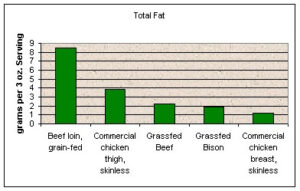
    There are a number of nutritional differences between the meat of grass-fed pasture-raised and grain-fed animals. To begin with, meat from grass-fed cattle, sheep, and bison is lower in total fat. If the meat is very lean, it can have one third as much fat as a similar cut from a grain-fed animal. In fact, as you can see by the graph below, grass-fed beef can have the same amount of fat as skinless chicken breast, wild deer, or elk. Research shows that lean beef actually lowers your “bad” LDL cholesterol levels

    Because meat from grass-fed animals is lower in fat than meat from grain-fed animals, it is also lower in calories. (Fat has 9 calories per gram, compared with only 4 calories for protein and carbohydrates. The greater the fat content, the greater the number of calories.) As an example, a 6-ounce steak from a grass-finished steer can have 100 fewer calories than a 6-ounce steak from a grain-fed steer. If you eat a typical amount of beef (66.5 pounds a year), switching to lean grassfed beef will save you 17,733 calories a year—without requiring any willpower or change in your eating habits. If everything else in your diet remains constant, you’ll lose about six pounds a year. If all Americans switched to grassfed meat, our national epidemic of obesity might diminish.

    As producers of grass-fed beef we have been working at ways to increase the amount of marbling in the meat so that consumers will have a more familiar product. But even these fatter cuts of grass-fed beef are lower in fat and calories than beef from grain-fed cattle.

    Extra Omega-3s. Meat from grass-fed animals has two to four times more omega-3 fatty acids than meat from grain-fed animals. Omega-3s are called “good fats” because they play a vital role in every cell and system in your body. For example, of all the fats, they are the most heart-friendly. People who have ample amounts of omega-3s in their diet are less likely to have high blood pressure or an irregular heartbeat.  Omega-3s are essential for your brain as well. People with a diet rich in omega-3s are less likely to suffer from depression, schizophrenia, attention deficit disorder (hyperactivity), or Alzheimer’s disease.

    Another benefit of omega-3s is that they may reduce your risk of cancer. In animal studies, these essential fats have slowed the growth of a wide array of cancers and also kept them from spreading. Although the human research is in its infancy, researchers have shown that omega-3s can slow or even reverse the extreme weight loss that accompanies advanced cancer and also hasten recovery from surgery.

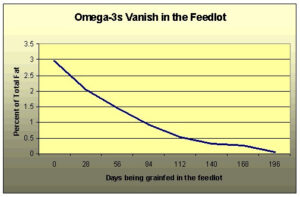
    Omega-3s are most abundant in seafood and certain nuts and seeds such as flaxseeds and walnuts, but they are also found in animals raised on pasture. The reason is simple. Omega-3s are formed in the chloroplasts of green leaves and algae. Sixty percent of the fatty acids in grass are omega-3s. When cattle are taken off omega-3 rich grass and shipped to a feedlot or fed grain to be fattened on omega-3 poor grain, they begin losing their store of this beneficial fat. Each day that an animal spends on grain, its supply of omega-3s is diminished. The graph below illustrates this steady decline.  So you can see the importance of not only having a grass-fed beef but a grass-finished beef.  You will hear many producers say they have grass fed beef but they grain them for a few months to fatten them up.  Here you can see in about 3 months 75% of the omega-3s are lost.

    When chickens are housed indoors and deprived of greens, their meat and eggs also become artificially low in omega-3s. Eggs from pastured hens can contain as much as 10 times more omega-3s than eggs from factory hens.

    It has been estimated that only 40 percent of Americans consume an adequate supply of omega-3 fatty acids. Twenty percent have blood levels so low that they cannot be detected. Switching to the meat, milk, and dairy products of grass-fed animals is one way to restore this vital nutrient to your diet.

    The CLA Bonus. Meat and dairy products from grass-fed ruminants are the richest known source of another type of good fat called “conjugated linoleic acid” or CLA. When ruminants are raised on fresh pasture alone, their products contain from 300-500% more CLA than products from animals fed conventional diets. (A steak from the most marbled grass-fed animals will have the most CLA ,as much of the CLA is stored in fat cells.)

    CLA may be one of our most potent defenses against cancer. In laboratory animals, a very small percentage of CLA—a mere 0.1 percent of total calories—greatly reduced tumor growth.  There is new evidence that CLA may also reduce cancer risk in humans. In a Finnish study, women who had the highest levels of CLA in their diet, had a 60 percent lower risk of breast cancer than those with the lowest levels. Switching from grain-fed to grass-fed meat and dairy products places women in this lowest risk category.  Researcher Tilak Dhiman from Utah State University estimates that you may be able to lower your risk of cancer simply by eating the following grassfed products each day: one glass of whole milk, one ounce of cheese, and one serving of meat. You would have to eat five times that amount of grain-fed meat and dairy products to get the same level of protection.

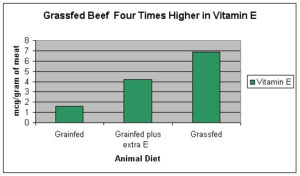
    Vitamin E. In addition to being higher in omega-3s and CLA, meat from grassfed animals is also higher in vitamin E. The graph below shows vitamin E levels in meat from: 1) feedlot cattle, 2) feedlot cattle given high doses of synthetic vitamin E (1,000 IU per day), and 3) cattle raised on fresh pasture with no added supplements. The meat from the pastured cattle is four times higher in vitamin E than the meat from the feedlot cattle and, interestingly, almost twice as high as the meat from the feedlot cattle given vitamin E supplements.

    Beta-Carotene is one of the other vitamin benefits of Grass-fed and pasture meats and eggs.  Take a look at the fat of grass-fed meat, raw it has a yellow tint.  Cooked Grass-fed fat can turn orange.  This is the beta-carotene from the grass working its way into the cattle’s fat deposits.  People often ask us how we get those bright orange yolks in our eggs.  Our hens are out on pasture eating grasses and legumes that provides them with an excess of vitamin E and beta-carotene that makes its way into our food.

    The truly wonderful fact about grass-fed pasture meats is we can eat the food we want,  food that tastes great and it is good for us as well.

  • Why Grass-Fed Beef and Lamb – Part 3, Livestock Health

    Why Grass-Fed Beef and Lamb – Part 3, Livestock Health

    While all animals will benefit from being pastured here we are talking about being grass-fed to finish and why that would benefit ruminants specifically.  In Part 1 of this series I defined what grass-fed to finish meant, now I must discuss what type of animals are ruminants.  While we humans are mono-gastric or one stomach, ruminants have a 4 chamber or stomached digestion systems, one of those chambers is called a rumen hence they are called ruminants. So mono-gastric animals like humans, hogs. chickens, raccoons are omnivores.  Their digestions systems are designed to be able to breakdown everything from grains, berries, complex carbohydrates to fat and animal proteins.  As the name implies OMNIvores can eat almost anything.  While all ruminants are first herbivores therefore can only eat plant based diets, the way the rumen functions makes them happier and less stressed and healthier if they eat only grasses and legumes.

    The rumen functions like a big fermentation tank.  The grass goes through a series of stomachs after being chewed, sometimes chewed twice in case of cud chewing animals then ends of in the rumen like a green grass slurry where it will sit and ferment like a big old batch of sauerkraut.  The the lower digestion system will leach out the nutrients from this fermented slurry. The grasses in this case are really only half digested which is why cow manure make great fertilizer, why chickens and hogs will actually eat it and why it is still green.

    Fresh pasture and dried grasses are the natural diet of all ruminant animals. In factory farms, animals are switched to an unnatural diet based on corn and soy. But corn and soy are not the only ingredients in their “balanced rations.” Many large-scale dairy farmers and feedlot operators save money by feeding the cows “by-product feedstuffs” as well. In general, this means waste products from the manufacture of human food. In particular, it can mean sterilized city garbage, candy, bubble gum, floor sweepings from plants that manufacture animal food, bakery, potato wastes or a scientific blend of pasta and candy.

    Here are some of the “by-product feedstuffs commonly used in dairy cattle diets in the Upper Midwest.”*

    1) Candy –  Candy products are available through a number of distributors and sometimes directly from smaller plants… They are sometimes fed in their wrappers…. Candies, such as cull gummy bears, lemon drops or gum drops are high in sugar content.
    2) Bakery Wastes –  Stale bread and other pastry products from stores or bakeries can be fed to dairy cattle in limited amounts. These products are sometimes fed as received without drying or even removal of the wrappers.
    3) Potato Waste – is available in potato processing areas, and includes cull potatoes, French fries and potato chips. Cull fresh potatoes that are not frozen, rotten, or sprouted can be fed to cows either whole or chopped. Potato waste straight from a processing plant may contain varying amounts of inedible or rotten potatoes. French fries and chips contain fats or oils from frying operations.
    4) Starch –  Unheated starch is available from some candy manufacturers and sometimes may contain pieces of candy.
    5) Pasta is available from pasta plants and some ingredient distributors as straight pasta or in blends with other ingredients, such as candy.

    So what happens to these animals after eating this corn and soy based diet with the possibility of eating junk food as well?

    1) The first negative consequence of a feedlot diet is a condition called "acidosis." During the normal digestive process, bacteria in the rumen of cattle, bison, or sheep produce a variety of acids. When animals are kept on pasture, they produce copious amounts of saliva that neutralize the acidity. A feedlot diet is low in roughage, so the animals do not ruminate as long nor produce as much saliva. The net result is "acid indigestion."

    2) Over time, acidosis can lead to a condition called "rumenitis," which is an inflammation of the wall of the rumen. The inflammation is caused by too much acid and too little roughage. Eventually, the wall of the rumen becomes ulcerated and no longer absorbs nutrients as efficiently.

    3) Liver abscesses are a direct consequence of rumenitis. As the rumen wall becomes ulcerated, bacteria are able to pass through the walls and enter the bloodstream. Ultimately, the bacteria are transported to the liver where they cause abscesses. From 15 to 30 percent of feedlot cattle have liver abscesses.

    4) Bloat is a fourth consequence of a feedlot diet. All ruminants produce gas as a by-product of digestion. When they are on pasture, they belch up the gas without any difficulty. When they are switched to an artificial diet of grain, the gasses can become trapped by a dense mat of foam. In serious cases of bloat, the rumen becomes so distended with gas that the animal is unable to breathe and dies from asphyxiation.

    5) Feedlot polio is yet another direct consequence of switching animals from pasture to grain. When the rumen becomes too acidic, an enzyme called "thiaminase" is produced which destroys thiamin or vitamin B-1. The lack of vitamin B-1 starves the brain of energy and creates paralysis. Cattle that are suffering from feedlot polio are referred to as "brainers."

    Typically, feedlot managers try to manage these grain-caused problems with a medicine chest of drugs, including ionophores (to buffer acidity) and antibiotics (to reduce liver abscesses). A more sensible and humane approach is to feed animals their natural diet of pasture, to which they are superbly adapted.

    As you can probably tell by now I can go on and on on this subject.  I haven’t spent any time on the benefits of the grass diet yet and really don’t much need to spend any time on it.  If all a grass based diet did was avoid all the problems of a grain based diet that would be good enough.  But when we explore the benefits to human health next week you will see we inherit the good health of the grass-fed beef though their nutritious meats.

  • Why Grass-Fed Beef and Lamb – Part 2, Environmental Benefits

    Why Grass-Fed Beef and Lamb – Part 2, Environmental Benefits

    In consideration of the impacts of grass-fed beef, we will consider both the positive benefits to the environment,  through the use of holistic farming and grazing practices we can actually heal the land and the environment as well as the important goal of stopping the negative impacts that conventionally fed beef can cause to the environment.

    When we talk about holistic grazing practices, we are talking about managing the whole.  We consider the land, the grass and the needs of the livestock to help develop a plan to maximize all three to the detriment of none of them.  The land and the dirt needs cover and microbes so we need to insure we provide that type of habitat.  The grass needs to go through a whole 30-45 day reproductive cycle to flourish.  The cattle need to graze before the grass browns and dries while its at its most nutritious.  The timing of our grazing plan needs to incorporate the seasons as well.  I can grow 12″-16″ of grass in 3 weeks in May but would take 6 weeks in August.  It is not my intent to teach you how to do a grazing plan, but to explain to think holistically and to incorporate all of the environment the land, the grass and the livestock to build a balanced plan.   We use techniques such as rotational or strip grazing and move some groups of cattle daily.  To execute these plans to maximize productivity as well as minimize the impact on the land.  We also do multi-species grazing  to take full advantage of natural diversity.

    I want to include a copy of a TEDTalk from Allan Savory.  It is a 22 minute video that explains how livestock can be used holistically to heal our earth as well as maybe the ONLY way to combat climate change and the desertification of earth.  It is a revolutionary talk that I really enjoyed and hope you do as well, it is well worth your time.

    Wow!!  You can eat a strip steak and fight climate change.  Just make it the right strip steak.  Here is a very short video on our rotational grazing techniques that we use here at the farm.

    A holistic system that was designed to mimic nature.  Like the Great Plains of North America or the Great Savannahs of Africa where dozens of feet of top soil were created that we still farm to this day, holistic systems like ours have the large herbivores(buffaloes/cattle) go through the the grass first, eating most and trampling a lot to decay as cover, followed by the small herbivores(antelopes/Sheep) next finish eating the grass and the trampling.  And finally followed by the birds(herons/chickens).  The birds clean up the insects and spread the manure out.  This holistic system which had the (animal in nature/then the animal on our farm) in parentheses shows how diversity in agriculture can be used to heal the environment.

    This system where we bring the animals to the food in an environment where the livestock fertilizes the earth is in contrast to a conventional system that uses diesel fuel to bring the food to the animals, that needs to use synthetic fertilizers to feed the plants that feed the livestock.  The livestock are held in CAFO(concentrated animal feeding operation).  With animals so close together in these CAFO they need to use antibiotics to prevent the spread of disease.  Manure instead of being an asset in a holistic environment becomes a toxic waste the needs to be disposed of.  Here is a picture of a toxic manure lagoon associated with a cattle feed lot.  Pictures of CAFO feedlots  .

    Therefore in a grass-fed to finish operation that uses holistic techniques is a system that takes advantage of natures diversity and one members input is another members output.  There is no waste, fewer inputs necessary, less dependent on diesel and synthetic fertilizers.  I believe the evidence that not only is grass-fed beef better for the environment that conventionally raise bee, it is out right good for the environment by the level of carbon sequestration that can be achieved.

    Next week we will see why grass-fed is better for the livestock themselves.

  • Why Grass-Fed Beef and Lamb – Part 1, Introduction

    Why Grass-Fed Beef and Lamb – Part 1, Introduction

    The first issue we must address when dealing with the subject of grass-fed beef and lamb is "what does grass-fed mean".  Before my wife Connie and I started raising grass-fed beef I was curious like some of you might be about what the difference between grass-fed and conventional beef might be or what it tastes like.  So I asked her to investigate and she went to our butcher and asked for some grass-fed beef.  Our local butcher at the time told her "honey all cows eat grass".  So there is the possibility that  you might have heard about grass-fed beef and asked about and were told this beef is grass-fed just like Connie was told.

    But there is an official definition and protocols for grass-fed beef established by the American Grassfed Association .  I will try to net this out for you, to be grass-fed an animal should be first grass-fed to finish.  Finish or finished is a beef industry term that describes an animal that has been raised to the adult or mature age and has been fattened to the point it can be harvested.  So grass-fed to finish means it has been grass-fed for it’s entire life.  No non-grass products ever.  Some farmers will raise an animal on grass almost its entire life then "finish" them on feed and grain the last few months of their life to "fatten them up".  This works for some farmers but this is not grass-fed beef.  We will deal with this particular objection more when we discuss the health benefits of grass-fed beef.  

    So if grass-fed to finish means it eats grass their entire life what counts as grass?  The simple answer is no seeds or grains, just leaves.  So what can a grass-fed animal eat?  First their are perennial grasses like fescue, timothy, orchard grass and rye grass.  They can eat legumes like red clover, white clover and alfalfa.  They can also eat annuals versions of the same, some annual grasses are sorghum and sudan grasses that can only grow in the summer time here in Ohio.  Grass-fed animals can also eat these fresh in pasture or in a stored form.  Stored grass is typically called hay.  So hay is just grasses and legumes that have been cut, dried and collected up to feed later.  They can also be store without drying if they are wrapped in which case it then ferments and is called haylage.  So for an animal to be called grass-fed it can eat grasses and/or legumes either directly from a pasture or in a stored for such as hay for it whole life.

    As I will detail later there are many benefits to the livestock, consumer, environment and local community to buying and eating grass-fed products.  But one of the most important of these is it tastes better.  There is a distinct flavor to grass fed beef that is easy to recognize and enjoy.  It is all about taste when it comes to food because no matter how healthy or good it is if it doesn’t taste good folks just wont buy or eat it.  So as a grass-fed producer I taste every head of cattle we produce to help us constantly improve.  So it is important to note that you don’t have to suffer lower quality or less taste to enjoy all the health benefits of grass-fed beef.