

I’m certainly no fan of Vladimir Lenin, but I love one of his quotes: “There are decades where nothing happens, and then there are weeks where decades happen.” Change in our world is not smooth and linear. It comes in bursts and spurts. Recognizing when we are in one of those periods and responding accordingly is important. I think about this quote often when looking at today’s interesting and rapidly shifting world of beef.
A complex series of events – COVID labor shortages, drought, higher prices of equipment, etc. – has caused the supply of cattle in the US to drop to its lowest levels since 1951…75 years ago! The population of the US in 1951 was 150 million. Today it is 350 million.
Also, the number of breeder cows in the US (those who give birth to the animals that become our beef in 2-3 years) has shrunk by 13%(!) since 2019. With the high prices of cattle and interest rates, many ranchers are reluctant to rebuild their herds, opting to sell beef for slaughter at high prices today. This tightening of supply has been the primary driver (along with lower imports) of the high prices we’re seeing.
Beef demand continues to grow very strongly. Despite these record high prices for beef, demand grew 7-8% last year and is expected to continue to outpace the growth of other meats like chicken and pork. We are definitely seeing signs of this at Tierra Verde.
When supply increases or demand decreases, prices go down. Neither one of these circumstances appear to be likely anytime soon in the world of beef.
You may ask, “You’re raising your own calves, so does this really affect you?”. Yes, in two specific ways.
First, most farms like ours have a few trading partners – farms that share the same practices/protocols and can be mutually helpful to keep supply consistent. On occasion, we will buy finished steers from specific farmers we know and trust deeply. We will also sell animals. This week we sold 10 live finished hogs to another farmer who is running short on pork. It was always relatively easy to do this with beef. There was a small but stable supply available at the quality level we demand, a standard that really cuts down our possible supply. The price, while higher than we liked, was digestible. Now, we don’t have the same level of known supply, and the prices are significantly higher.
Second, there seems to be squeezing of price differences between large-scale operations beef and products like ours. As large-scale prices increase, we are seeing more and more people who would rather pay a little bit more to get the quality of what we’re providing. That creates (wonderful) additional demand pressures on us to serve you.
In the midst of all of these factors, we looked at options to make sure we grow the highest quality beef possible, meet growing demand, and protect our ability to produce from outside market factors. It became crystal clear that we needed to grow the size of our beloved herd of breeding cows.
At the end of 2025, we took the big step of moving our mama cows and their calves a bit south of Canton, near Gnadenhutten. Some great friends with Green Hills Grazing have 3,000+ acres of available grasslands for them to live on, taking significant pressure off of the land in Deerfield. Given the extra rest, we’re amazed at how incredibly lush the grass is this year compared to last year with fewer animals on the land. We are really pleased with the growth we’re seeing on them. This shift has also been a game changer to help us get some breathing room on the TVF acreage and grow our capacity. Now, the TVF pastures will be used to improve our grass finishing processes so we can more closely monitor the cattle as they are drawing close to processing.
In April we became aware of a herd of 22 pure Devon bred (pregnant) cows that were possibly going up for sale. A farmer in the southern tier of New York was looking to downsize his overall farming operation. Instead of selling them off piecemeal, we would be interested in taking the whole herd, so we thought this might be a chance to get some great Devons in a win/win deal.
Steve and his wife Mel took a trip to see these ladies in April. They looked really good, and some were already starting to have calves. After some negotiation we committed to purchase them and started planning the logistics to get them back to Ohio. I’ve worked with Steve for a while and have yet to see him really nervous about anything. He was nervous about this move, though. There were some real logistical challenges with this move, mostly before getting them on the truck.
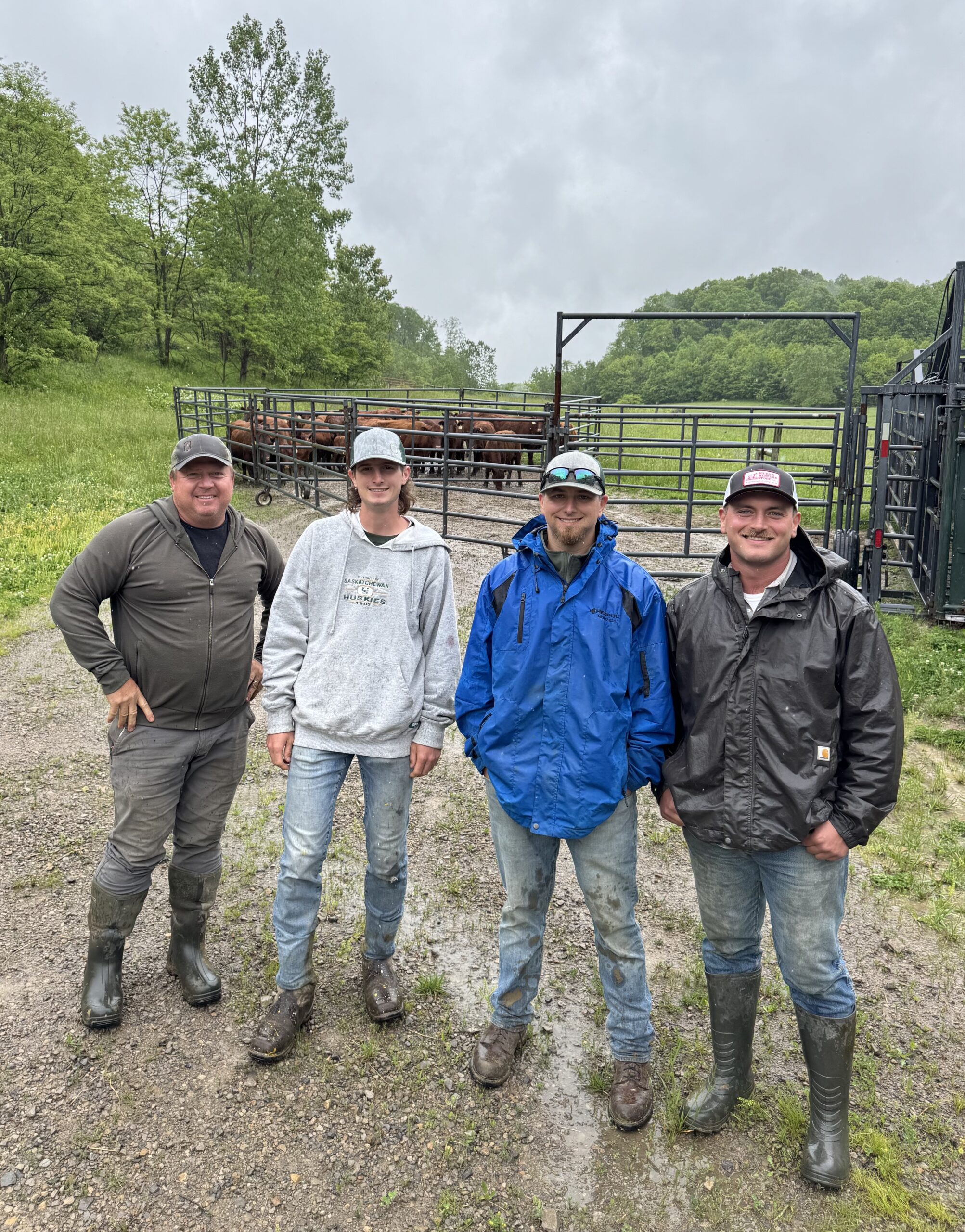
The first problem was that the farmer had all of these animals all mixed in with a few dozen other head of cattle that were in a large field. Separating these animals and their calves, and then guiding them into a corral was going to be no small feat. He committed to getting this done before we arrived, but it was still a relief to see that he had done it. There remained a couple challenges, though…there were two additional calves in the corral that were not offspring of the Devons! We played matchmaker by getting up early the next morning and observing which calves were not matched up, and seeing which cows in the field were calling at their baby in the corral. We then had to tag and record the 12 remaining calves to their mothers.
Second, we had to figure out how to mix in calves and cows on the trailer. At Tierra Verde, we breed our calves in a precise manner. Each year in mid-July, the bull is let in with the cows for two months (cows are fertile on a 3-week cycle, so this allows for some margin of error). Our calves are then all born in the same window, late April through June. This farmer was not so deliberate, and we had a wide range of pregnancy dates. Some of these cows had six week-old calves, while some were weeks from giving birth. We ultimately decided that the safety of separating cows and calves in different sections in the trailer outweighed the benefit of keeping them together for the 4-1/2 hour journey.
Third, we had two ladies who had given birth in the prior day. Their calves were robust but still smaller than the others. One thing to note is that newborn calves just lay around for the first couple days. They aren’t looking to stand on a trailer for hours like the rest of their herd mates. Thankfully, we have a small compartment in our livestock trailer that suited these little fellows well. We also were concerned about cows giving birth on the trailer, something that’s more common than you’d think.
We sorted things out and we were able to get the whole crew to the new pasture safe and sound. No travel births either, which was a relief.
We rolled into the Green Hills land and the reunions began! It is always such an amazing thing to see the powerful connection between mom and baby in the bovine world, especially with the young age of these calves. Seeing the fierceness that the moms have in getting their kiddos back – almost scolding them – to nursing is amazing. Interestingly, while we were in New York, Jackson, who handles our breeding cow herd, was dealing with a situation where he needed to create this linkage artificially because of some sad circumstances in our existing, currently calving herd.
One of our ladies gave birth to twins, but quickly rejected one of them. This is not uncommon. Nursing is incredibly hard and calorie-intensive on a mother, and if she believes that she can only sustain one calf, she’ll make the decision to focus on the stronger one. Bottle-feeding in this situation is not feasible. A few days later, we had a young calf who was stillborn. This presented a chance to help the overall situation with something pretty crazy.
Grafting is a process where you skin a dead calf and wrap the rejected one in the hide. Because cows link to their young by smell, there’s a good chance that the mom of the dead calf will adopt the familiar-smelling youngster. Jackson had never done this before, but Steve had. He talked Jackson through the process over the phone. That very day the mom was nursing the incognito calf. Jackson removed the hide 4 days later, and the pair has deeply bonded in the 2 weeks since. Simply amazing (see photo of the pair below). The rest of the ladies and their young have taken to the land nicely.
With this new crew of 22 landed in addition to the 50 we already had, and are now a bit closer to our target of 90 cows in the breeding herd. We’re going to continue to keep our eyes open over the coming year or so to close the gap. They say Warren Buffet started his career buying fair companies at a great price, but shifted to buying great companies at a fair price. We have been and will be aligned with the second pathway. We’ll only do so, though, when we are at a high level of certainty about the quality of animal we’re buying.
We started with some very high-level perspectives on the industry, and ended this on the ground, in the dirt. I hope this gives you some insight into how we think about our work here at Tierra Verde. We’re so grateful for the trust you put in us; we’re doing everything in our power to ensure we’re worthy of that trust.